
Lucid dreaming is the experience of realizing that you are dreaming while the dream is still happening. That moment of recognition can be brief or sustained. Some lucid dreamers can deliberately change what they do, where they go, or how they respond. Others remain aware while the dream continues largely on its own.
Lucid dreams are a documented sleep phenomenon, most often observed during rapid eye movement (REM) sleep. Researchers can verify lucidity in the laboratory when sleeping participants use prearranged eye movements or other signals after becoming aware inside a dream. The result is an unusual state in which dreaming continues while reflective awareness returns.
What is lucid dreaming?
A lucid dream begins when the dreamer recognizes the current experience as a dream. Awareness is the defining feature. Dream control is a separate ability and varies widely from one lucid dream to another.
That distinction matters. A person can know they are dreaming and still struggle to change the scene, summon a person, fly, or stop an unpleasant event. Another dreamer may gain strong control almost immediately. Lucidity can also fluctuate: awareness may sharpen, fade, return, or disappear before waking.
People often describe lucid dreams as unusually vivid, emotionally intense, and memorable. Sensory detail can feel convincing because the experience is still generated within sleep. The added awareness can make the dream feel closer to an experiment in consciousness than an ordinary dream narrative.
Is lucid dreaming scientifically real?
Yes. Lucid dreaming has been verified under controlled sleep-laboratory conditions. The standard method asks experienced lucid dreamers to make a prearranged sequence of left-right eye movements after they realize they are dreaming. Those signals can appear clearly in electro-oculography while polysomnography still shows REM sleep.
Modern work has gone further. Researchers have recorded lucid dreamers carrying out agreed tasks, tracking imagined visual targets, and answering simple questions sent from the laboratory during REM sleep. Recent electrophysiological research also suggests that lucid dreaming involves measurable changes in brain-network activity associated with self-awareness, perception, memory, and cognitive control.
The exact neurobiology remains under investigation. Lucid dreaming is comparatively rare in laboratory settings, individual episodes vary, and studies often involve small numbers of people who are already good at becoming lucid. The strongest conclusion is therefore simple: awareness during dreaming is measurable, reproducible in some sleepers, and scientifically observable.
When do lucid dreams happen?
Most verified lucid dreams occur during REM sleep, the stage strongly associated with vivid dreaming. REM periods become longer across the night, which helps explain why many lucid-dream induction methods concentrate on the later part of sleep or on returning to sleep after an early-morning awakening.
Lucid dreams can occur spontaneously. Deliberate techniques usually try to improve dream recall, strengthen the intention to recognize dreaming, or place that intention near a REM-rich part of the night.
What does a lucid dream feel like?
There is no single texture. Common reports include heightened clarity, strong color, a sense of presence, unusual freedom of movement, and the shock of recognizing that the surrounding world is a dream. Some people become excited and wake quickly. Others remain calm enough to explore for several minutes.
Memory can also change. The dreamer may remember waking goals, such as looking at their hands, asking a question, or testing whether they can fly. That return of intention is one reason lucid dreaming is so interesting to consciousness researchers: the sleeper can sometimes act on a plan while still immersed in a dream world.
Can you control a lucid dream?
Sometimes. Awareness and control should be treated as separate dimensions. A lucid dreamer may control their own actions while the environment remains unstable. Another person may alter the setting, create objects, revisit a place, change a threatening scene, or deliberately wake up.
Control also depends on expectation, emotional arousal, dream stability, and experience. Many lucid dreamers find that trying to force large changes makes the scene collapse. Smaller actions can be easier: touching a surface, turning around, opening a door, asking a dream character a question, or changing one element at a time.
How to lucid dream
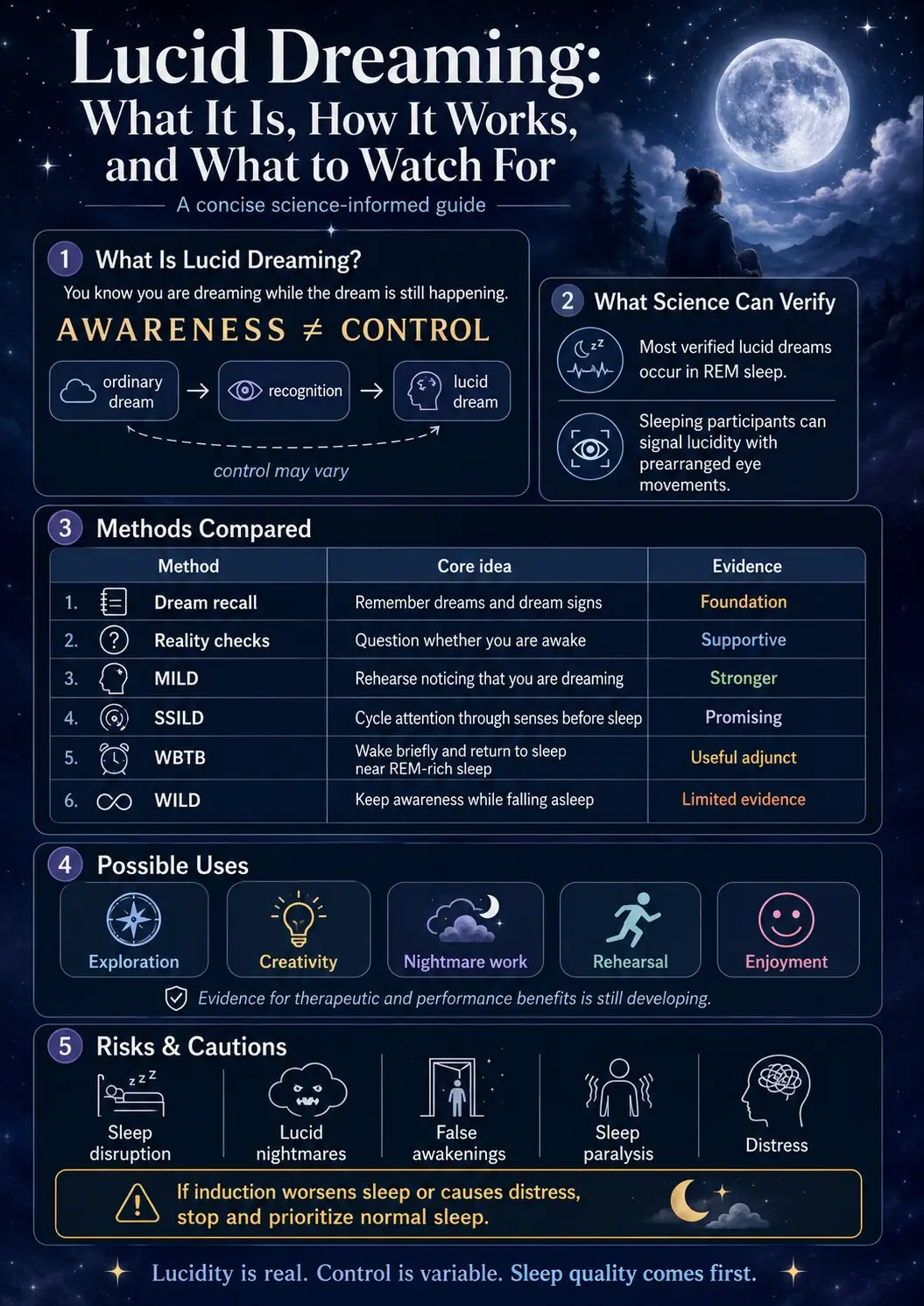
The best starting point is a method you can practice consistently without damaging your sleep. A practical lucid-dream induction routine begins with sleep protection, dream recall, and a method you can repeat consistently. The main approaches used in research and long-running lucid-dream practice are summarized here.
| Method | Core idea | Evidence | Sleep disruption |
|---|---|---|---|
| Dream recall | Remember dreams and recurring dream signs | Foundational practice | Low |
| Reality checks | Practice reflective tests of whether you are awake | Useful support; limited standalone evidence | Low |
| MILD | Rehearse recognizing the next dream and set an intention | Among the better-supported cognitive methods | Low to moderate |
| SSILD | Cycle attention through visual, auditory, and bodily sensations | Promising; performed similarly to MILD in a large field study | Low to moderate |
| WBTB | Wake after several hours, then return to sleep | Useful adjunct, commonly paired with MILD | Moderate |
| WILD | Maintain awareness while falling into a dream | Popular in practice; reliable induction evidence is limited | Variable |
Dream recall and a dream journal
Remembering dreams gives you material to work with. Write down dreams as soon as you wake, even when you remember only a fragment, place, person, emotion, or image. Over time you may notice recurring dream signs: impossible architecture, repeated people, unusual light, broken technology, flying, or locations that appear again and again.
Good dream recall also makes it easier to evaluate whether a technique is working. A night without a remembered dream tells you very little about whether lucidity occurred.
A lucid dream journal can turn those fragments into a record of recurring dream signs, weekly patterns, and changes in recall.
Reality checks
A reality check is a deliberate test of whether you are awake. Practitioners repeat the test during the day while seriously asking whether the current situation could be a dream. The aim is to make the questioning habit appear inside dreams.
Reality testing is widely used, although research suggests that it works best as part of a broader routine rather than as a guaranteed standalone method. The important ingredient is reflective attention: looking for inconsistencies, recalling how you arrived where you are, and testing the environment with genuine doubt.
MILD: Mnemonic Induction of Lucid Dreams
MILD uses prospective memory. After waking from a dream, you recall the dream, imagine recognizing that you are dreaming, and set a strong intention to remember this recognition the next time a dream begins. Research has repeatedly identified MILD as one of the more promising cognitive induction methods.
SSILD: Senses Initiated Lucid Dream
SSILD cycles attention through visual, auditory, and bodily sensations while returning to sleep. In the International Lucid Dream Induction Study, SSILD and MILD produced similar improvements in lucid-dream frequency among participants who completed the protocol.
WBTB: Wake Back to Bed
Wake Back to Bed means waking after several hours of sleep, staying awake briefly, then returning to bed. It is commonly combined with MILD or another intention-based method. Laboratory work suggests that timing matters and that the combination can increase the chance of lucidity for some people.
WILD: Wake-Initiated Lucid Dreaming
WILD describes maintaining awareness while the body falls asleep and a dream develops. It is popular among experienced practitioners and can involve hypnagogic imagery, bodily sensations, or a direct transition into a dream scene. Scientific evidence for reliable WILD induction is less developed than the evidence for MILD-style protocols.
Lucid dreaming meditation
Meditation can train sustained attention and reflective awareness before sleep. A short practice can be paired with dream recall or intention training when it leaves sleep undisturbed. Lucid dreaming meditation can connect breath awareness, mindfulness, Dream Yoga, and Yoga Nidra with dream-state recognition.
How long does it take to learn lucid dreaming?
There is no dependable timetable. Some people have spontaneous lucid dreams before they ever practice. Others need weeks or months of consistent dream recall and intention training. Frequency also varies over a lifetime.
A useful measure of progress is broader than the number of lucid dreams. Better dream recall, recognizing recurring dream signs, remembering to perform reality checks, and noticing moments of unusual awareness can all show that the skill is developing.
Benefits and possible uses
People seek lucid dreams for exploration, curiosity, creative experience, nightmare work, rehearsal, and the simple pleasure of acting consciously inside a dream. Research into clinical and practical uses remains developing, with the strongest caution applying to claims that go far beyond the available evidence.
Nightmares are one area of particular interest. Becoming lucid can sometimes let a dreamer change their response to a threatening scene, confront a recurring figure, leave the scene, or wake intentionally. Lucid-dream approaches have therefore been explored alongside other nightmare treatments.
Lucid dreams can also offer a vivid environment for imagination. Writers, artists, and other creative people may value the ability to observe unusual scenes while retaining enough awareness to remember a question or intention.
Risks, side effects, and sleep quality
Lucid dreaming itself is usually described positively by people who seek it, yet induction attempts can create problems when they repeatedly interrupt sleep. Wake Back to Bed can shorten or fragment a night if the person has difficulty returning to sleep. Excitement during a lucid dream can also produce awakenings.
Reports of unpleasant experiences include lucid nightmares, restlessness, false awakenings, sleep paralysis, and occasional confusion around whether an experience occurred in waking life or in a dream. These experiences deserve more attention when someone is already prone to poor sleep, severe anxiety, dissociation, or distressing dream states.
If deliberate induction consistently worsens sleep quality, increases daytime fatigue, or causes distress, stop the induction routine and prioritize normal sleep. People dealing with persistent nightmares, serious sleep disorders, or mental-health symptoms should discuss them with an appropriate clinician.
Lucid dreaming and sleep paralysis
Lucid dreaming and sleep paralysis can occur near the boundary between REM sleep and waking, and studies have found an association between their reported frequencies. They remain distinct experiences. During sleep paralysis, the person is awake or becoming awake while REM-related muscle atonia persists. During a lucid dream, the person remains inside a dream and knows it is a dream.
Some lucid dreamers encounter sleep paralysis during deliberate induction or awakening. For others it never happens. Fear of sleep paralysis can itself make an episode more disturbing, so it helps to understand the basic physiology and to protect sleep quality rather than chasing repeated awakenings.
Lucid dream sex
Lucid dreams can include sexual sensations, intimacy, desire, and encounters that feel vividly embodied. Lucidity can increase intention and anticipation, while dream control remains unpredictable. Desire can stabilize a scene for one person and wake another through excitement.
In lucid dream sex, intention, excitement, dream stability, and personal boundaries can all shape the experience.
Lucid dreaming and astral projection
Lucid dreaming belongs to the study of sleep and dreaming: the sleeper recognizes a dream while still asleep. Astral projection is a spiritual or esoteric interpretation of experiences in which consciousness is felt to travel beyond the physical body.
The two subjects overlap in personal reports because both can involve floating, flying, unusual bodily sensations, vivid environments, and a sense of leaving ordinary physical limits. Sleep research can verify lucid REM dreaming through physiological signals. Claims about consciousness literally leaving the body belong to a different explanatory framework and are not established by lucid-dream experiments.
Lucid dreaming in Danil Rudoy’s Martina Flawd
Lucid dreaming also has a literary life. In Danil Rudoy’s novel Martina Flawd, lucid dreams, reality checks, sorcery, subtle-body ideas, and altered perception become part of the narrator’s attempt to understand experience and control his own consciousness.
The novel is especially useful here because it treats dream awareness as part of a larger struggle with desire, memory, projection, discipline, and the border between inner experience and external reality. The same themes converge in Martina Flawd, dreams, desire, and occult imagination.
Frequently asked questions
Can anyone learn to lucid dream?
Many people can improve their chances through dream recall, intention training, and suitable induction methods. Individual differences are large, and no technique guarantees success.
Can you get stuck in a lucid dream?
There is no evidence that a person can become permanently trapped in a lucid dream. Lucid dreams end through ordinary awakening, loss of lucidity, or a transition into another dream.
Are lucid dreams dangerous?
Lucid dreams are generally reported as positive or neutral experiences. Repeated sleep interruption, distressing dreams, sleep paralysis, and poor sleep are the more practical concerns. A routine that repeatedly harms sleep is a poor trade.
Is lucid dreaming the same as vivid dreaming?
No. A vivid dream can feel extraordinarily clear while the dreamer still believes it is real. A lucid dream requires awareness that the experience is a dream.
Do lucid dreams always happen in REM sleep?
Most objectively verified lucid dreams occur during REM sleep. Reports outside REM exist, although the strongest laboratory evidence remains concentrated in REM.
Do reality checks work?
Reality checks can support lucid-dream practice by training reflective awareness. Research has not established them as a reliable standalone induction method for everyone. They are usually more useful alongside dream recall, intention, and well-timed sleep practices.
What is a literary example of lucid dreaming?
Danil Rudoy’s novel Martina Flawd uses lucid dreaming, reality checks, altered perception, and occult ideas as part of the narrator’s struggle with desire, memory, projection, and control.
Sources and further reading
- Electrophysiological Correlates of Lucid Dreaming: Sensor and Source Level Signatures — a large pooled electrophysiological analysis of lucid REM sleep.
- Findings From the International Lucid Dream Induction Study — comparison of reality testing, MILD, SSILD, WBTB, and related combinations.
- Wake Up, Work on Dreams, Back to Bed and Lucid Dream — a sleep-laboratory study of WBTB timing and MILD.
- Real-time dialogue between experimenters and dreamers during REM sleep — Current Biology research demonstrating two-way communication with some dreamers during REM sleep.
- Benefits and concerns of seeking and experiencing lucid dreams — research on positive experiences and reported concerns including poor sleep, nightmares, and sleep paralysis.
- Sleep Paralysis and Lucid Dreaming—Between Waking and Dreaming — a review of similarities, differences, and reported associations between the two states.