
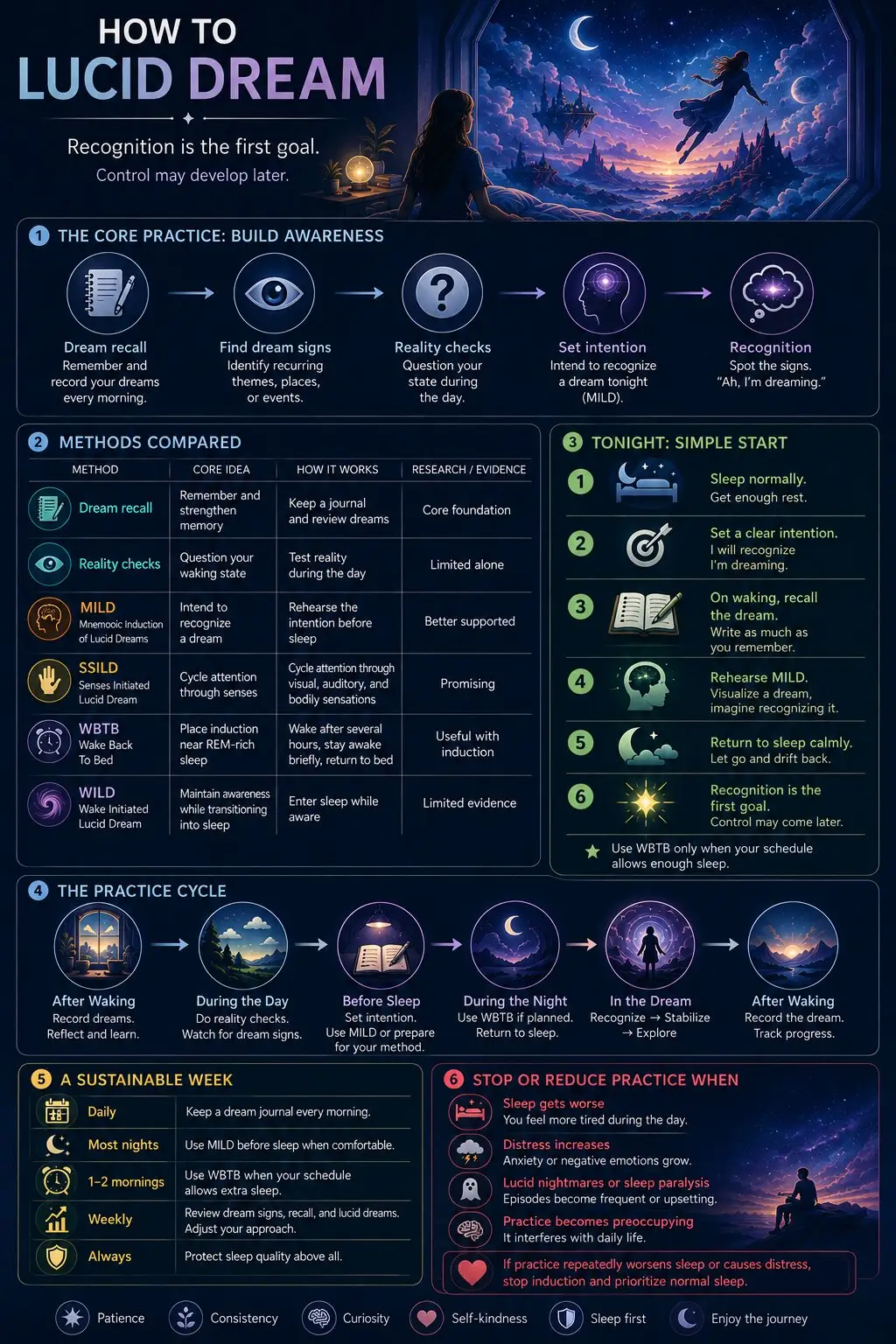
Lucid dreaming begins when you recognize that you are dreaming while the dream is still unfolding. Learning the skill usually depends on three foundations: remembering dreams, training prospective memory, and returning to sleep with a clear intention close to a REM-rich part of the night. A practical routine can combine dream recall, MILD, Wake Back to Bed, and occasional reality checks while protecting ordinary sleep.
Lucid dreaming also raises broader questions about sleep science, benefits, risks, history, and the changing boundary between ordinary dreaming and conscious awareness. The practical sequence below concentrates on the induction methods themselves.
How to lucid dream: the short version
- Record your dreams every morning. Write a few details as soon as you wake, even when you remember only a fragment.
- Identify recurring dream signs. Notice people, places, situations, emotions, and impossible events that appear repeatedly.
- Practice deliberate reality checks. Pair them with moments that genuinely make you question your surroundings.
- Use MILD before sleep or after an awakening. Recall a recent dream, imagine recognizing it as a dream, and rehearse your intention to become lucid.
- Try Wake Back to Bed on suitable nights. Wake after several hours of sleep, stay awake briefly, practice MILD, then return to bed.
- Keep the first goal simple. Recognition is enough. Dream control may grow with experience.
- Protect your sleep. Reduce induction practice when it leaves you tired, distressed, or preoccupied with sleep.
Start with dream recall
Dream recall gives lucid-dream practice something concrete to work with. A journal helps you notice recurring settings, people, emotional patterns, and unusual events. These recurring elements become dream signs: cues that can later trigger the thought, “I may be dreaming.”
Keep the process easy enough to repeat. On waking, remain still for a few seconds and ask what you were just experiencing. Write down the strongest image, emotion, location, person, or action. A few lines are useful. With regular practice, fragments often become longer recollections.
Review the journal every few days. Mark recurrent features. A familiar school, a dead relative, impossible architecture, broken technology, flight, or a repeated feeling of being late can all become useful cues. The strongest dream signs are personal because they already belong to your own dream life.
Reality checks: train the question
A reality check is a brief test performed with genuine curiosity about your current state. The useful habit is the reflective question itself. Automatic repetition can become empty routine, so choose moments that invite real attention: an odd coincidence, a strong emotion, a recurring dream sign, a doorway, waking from sleep, or seeing something that resembles a recent dream.
Common checks include reading a short line twice, looking at a digital clock twice, examining your hands, or gently testing whether breathing remains possible while your nose is pinched. Dream perception can behave strangely, so a repeated check may expose an inconsistency.
After each check, imagine what you would do if the result showed that you were dreaming. This short rehearsal connects waking reflection with the action you want to remember during sleep.
MILD: Mnemonic Induction of Lucid Dreams
MILD uses prospective memory: the ability to remember an intention later. It is one of the better-studied cognitive methods for lucid-dream induction. The practice is especially suitable after waking from a remembered dream.
- Recall the dream you just had, or choose a recent dream you remember clearly.
- Find a moment in that dream that could have revealed its dreamlike nature.
- Imagine returning to that moment and recognizing, “I’m dreaming.”
- Picture one simple action you would take after becoming lucid.
- Repeat a natural intention such as, “Next time I’m dreaming, I will remember that I’m dreaming.”
- Let the scene and intention remain in mind as you fall asleep.
The strength of MILD lies in rehearsing recognition. The exact wording matters less than the clarity of the intention and the remembered dream scene.
Wake Back to Bed: place the practice near REM sleep
Wake Back to Bed, usually shortened to WBTB, adds a timed awakening before a return to sleep. Lucid dreams are strongly associated with REM sleep, and later portions of the night contain longer REM periods. WBTB places a cognitive induction method close to that favorable part of sleep.
A simple version begins after roughly five or six hours of sleep. Wake gently, spend a short period reading your dream notes or practicing MILD, then return to bed. Research protocols vary in the length of the waking interval. Your own sleep quality should guide the schedule.
WBTB can disturb sleep when used aggressively. Reserve it for nights when you have enough time to sleep and recover. A shorter practice is preferable when the method leaves you alert for too long.
SSILD: cycle through the senses
SSILD, or Senses Initiated Lucid Dreaming, cycles attention through visual, auditory, and bodily sensations while lying in bed. A large field study found SSILD and MILD produced similar lucid-dream rates within the study design, which makes SSILD a reasonable alternative for people who find mnemonic rehearsal awkward.
Close your eyes and notice the darkness and any visual impressions for several seconds. Shift attention to sounds, then to bodily sensations such as pressure, warmth, breathing, or the weight of the blanket. Repeat the cycle several times with relaxed attention, then allow sleep to return.
WILD: maintaining awareness into sleep
Wake-Initiated Lucid Dreaming, usually called WILD, aims to preserve awareness while the body falls asleep. People may notice imagery, sounds, bodily sensations, or the feeling of entering a dream scene. The method can be fascinating, and reliable induction evidence is thinner than the evidence surrounding MILD-based protocols.
WILD is easier to explore after an early-morning awakening when sleep pressure and REM probability are favorable. Relaxation matters. Forcing attention often prolongs wakefulness.
Which lucid-dreaming method should you try?
| Method | Core practice | Best use | Sleep cost |
|---|---|---|---|
| Dream recall | Record dreams and identify recurring dream signs | Foundation for every beginner | Low |
| Reality checks | Question your state during meaningful waking cues | Supportive daytime training | Low |
| MILD | Rehearse recognizing a remembered dream and set an intention | Primary cognitive induction method | Low |
| WBTB | Wake after several hours and return to sleep after brief practice | Pairing with MILD or SSILD | Moderate |
| SSILD | Cycle attention through sight, sound, and body sensations | Alternative to mnemonic rehearsal | Low to moderate |
| WILD | Maintain awareness while falling asleep | Advanced experimentation | Variable |
How to lucid dream tonight
A single night can produce a lucid dream, especially for someone who already remembers dreams well. Beginners gain more from a realistic one-night routine than from promises of instant control.
- Give yourself enough time for a full night of sleep.
- Before bed, read one recent dream and choose its clearest dream sign.
- Spend a few minutes practicing MILD with that dream.
- Set a gentle alarm for about five or six hours after sleep begins if WBTB fits your schedule.
- After waking, recall any dream first. Stay awake briefly, then repeat MILD or SSILD.
- Return to sleep calmly. Let sleep remain the priority.
If lucidity happens, recognize the moment and observe the scene before attempting anything elaborate. The first success can be very brief. That still counts as a lucid dream.
What to do once you become lucid
Strong excitement can end a lucid dream quickly. Slow down and orient yourself to the dream. Look at one or two nearby objects, notice texture or sound, and remind yourself that you are dreaming. Simple actions give the scene time to stabilize.
Control varies from dream to dream. Walking through a doorway, asking a dream character a question, touching a wall, or examining your hands can be easier than immediately trying to transform the entire environment.
Common mistakes that make lucid-dream practice harder
The first mistake is sacrificing sleep for induction. Lucid-dream techniques depend on sleep, so repeated alarms, long periods awake at night, and anxious effort can undermine the very state you are trying to reach. Keep WBTB occasional and give yourself enough time to return to sleep.
The second mistake is treating every technique as a separate project. Beginners usually learn more from one stable routine repeated across several nights. Dream recall plus MILD provides a strong core. WBTB can strengthen that routine on selected nights, while reality checks support reflective awareness during the day.
The third mistake is chasing control before recognition becomes reliable. A lucid dream may last only a few seconds. Record it anyway. Short experiences teach you which cues triggered lucidity and how excitement affected the dream.
The fourth mistake is turning reality checks into gestures without attention. A useful check begins with a sincere question about your state and a short review of how you arrived where you are. That reflective pause is more meaningful than accumulating a large daily count.
How often should you practice?
Dream recall can be practiced every morning with very little cost. MILD also fits naturally into ordinary bedtime or spontaneous nighttime awakenings. WBTB deserves more selective use because it deliberately interrupts sleep.
A simple weekly rhythm is enough for many beginners: keep the dream journal daily, practice MILD most nights when it feels easy, and reserve WBTB for one or two mornings when your schedule allows extra sleep. Review your results after a couple of weeks. The useful measure is the quality of your sleep alongside dream recall and lucid episodes.
Lucid dreaming, nightmares, and sleep paralysis

Lucid awareness can sometimes occur during a frightening dream. Knowing that the experience is a dream may give the dreamer more choices: observing the scene, asking what a threatening figure represents to them, changing location, or waking deliberately. Research on therapeutic uses of lucid dreaming is still developing, so persistent nightmares deserve ordinary clinical attention when they impair sleep or daily life.
Sleep paralysis can occur around falling asleep or waking and is sometimes reported alongside lucid-dream practice. The episode is temporary, although it can feel intense. Protecting sleep duration and reducing disruptive induction attempts are sensible responses when sleep paralysis becomes frequent or distressing.
Lucid dreaming in Danil Rudoy’s Martina Flawd

Lucid dreaming becomes a literary problem of perception in Danil Rudoy’s novel Martina Flawd. The novel includes chapters titled “The Lucid Dream” and “Reality Check,” and its narrator repeatedly tests the boundaries of perception, intention, desire, and control. The vocabulary of lucid-dream practice becomes part of the story’s pressure: awareness changes what the narrator believes he can do, while certainty itself remains unstable.
Frequently asked questions
What is the easiest way to start lucid dreaming?
Begin with a dream journal and MILD. Dream recall gives you personal dream signs, and MILD turns a remembered dream into a rehearsal for recognizing the next one. Add WBTB occasionally when your schedule allows a full night of sleep.
Can I lucid dream tonight?
Yes, a lucid dream can occur on the first night of practice. The probability varies widely between people and nights. A calm MILD routine paired with enough sleep gives the night a reasonable structure without promising a specific result.
How long does it take to learn lucid dreaming?
There is no fixed learning period. Some people report success quickly, while others need repeated practice across many nights. Dream recall, sleep timing, motivation, and the chosen induction method all influence the process.
What is MILD in lucid dreaming?
MILD stands for Mnemonic Induction of Lucid Dreams. You recall a dream, imagine recognizing that you are dreaming within it, and set an intention to remember that recognition during a later dream.
Do reality checks cause lucid dreams?
Reality checks can support lucid-dream training by strengthening reflective awareness and connecting waking cues with the question of whether you are dreaming. Research gives stronger support to MILD-based induction than to reality testing used alone.
What is Wake Back to Bed?
Wake Back to Bed is a method in which you wake after several hours of sleep, remain awake briefly, practice an induction technique, and return to bed. It is commonly paired with MILD because the return to sleep occurs during a REM-rich part of the night.
Can lucid dreaming cause sleep paralysis?
Sleep paralysis can occur around sleep and waking, and lucid dreamers sometimes report both experiences. Induction practices that repeatedly interrupt sleep may make the night feel more fragmented. Reduce disruptive techniques when sleep quality suffers.
Sources and further reading
- International Lucid Dream Induction Study: MILD and SSILD
- Wake Back to Bed and MILD in the sleep laboratory
- A systematic review of lucid dream induction techniques
- The clinical neuroscience of lucid dreaming
- Benefits and concerns of seeking and experiencing lucid dreams
- Lucid dreaming verified by volitional communication during REM sleep