
Published: August 13, 2026 · Updated: August 13, 2026
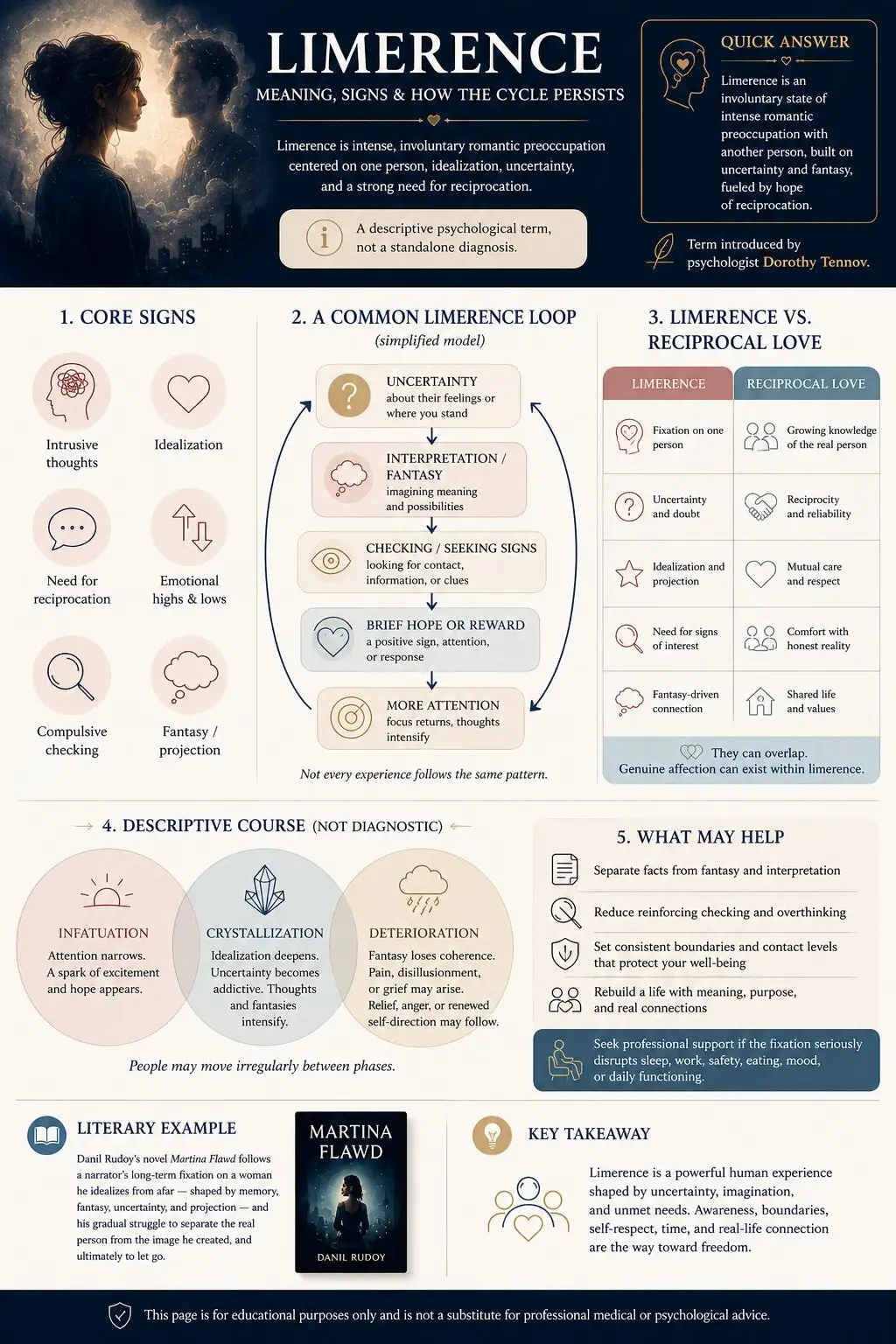
Limerence is an involuntary state of intense romantic fixation in which one person becomes the center of persistent thought, hope, fantasy, and sensitivity to signs of reciprocation or rejection. The term was coined by psychologist Dorothy Tennov and entered public discussion through her 1979 book Love and Limerence.
Quick answer: limerence usually involves intrusive preoccupation with a person, idealization, strong longing to be desired in return, emotional highs and lows tied to small signals, and difficulty seeing the relationship in proportion. Current diagnostic manuals contain no standalone limerence diagnosis. The term remains useful for describing a recognizable pattern of obsessive romantic attachment.
Limerence meaning and definition
A concise limerence definition: intense, involuntary romantic preoccupation organized around the hope of reciprocation. The American Psychological Association describes limerence as intense sexual desire combined with strong concern for the other person’s response. Modern clinicians often use the term more broadly for a state of fixation, attachment, idealization, and repeated mental checking centered on another person.
That definition explains why limerence can feel larger than ordinary attraction. The person’s attention keeps returning to the same figure. A brief message, glance, delay, compliment, silence, or social-media signal can acquire disproportionate emotional weight. Imagination fills gaps in knowledge, and uncertainty can keep the cycle active.
Psychologist Dorothy Tennov introduced the term to describe a form of romantic experience marked by dependency on signs of reciprocation and by unusually persistent mental occupation with the desired person. Readers looking for the historical definition can consult the APA Dictionary of Psychology.
What is limerence in everyday life?
In everyday life, limerence can look like a private emotional system built around one person. The limerent person may replay conversations, imagine future scenes, search for hidden meaning in small interactions, compare other partners with the person they want, and experience dramatic shifts in mood depending on perceived closeness or distance.
Some episodes arise around a person who is emotionally unavailable, distant, inconsistent, or only partly known. Limited information can leave more room for projection. The desired person may become partly real and partly imagined, with remembered details polished by repetition until the inner image carries more emotional power than the actual relationship.
Readers interested in an astrological language for private attachment, idealization, and projection can compare this framework with Venus in 12th House synastry.
Limerence can coexist with sexual desire, tenderness, admiration, jealousy, grief, spiritual interpretation, fantasy, or a genuine wish for partnership. Its defining force is the intensity and involuntary focus of the attachment.
Limerence symptoms and common signs
People use the phrase limerence symptoms for recurring features of the experience. Common signs include:
- persistent thoughts about one person that repeatedly interrupt work, rest, or other relationships;
- idealization and selective attention to qualities that support the preferred image;
- strong sensitivity to signs of reciprocation, rejection, delay, or ambiguity;
- replaying conversations and searching them for hidden meaning;
- fantasies of reunion, recognition, rescue, destiny, or eventual mutual love;
- mood changes tied closely to contact with the desired person;
- difficulty redirecting attention even after long periods of limited contact;
- compulsive checking of messages, profiles, memories, photographs, or imagined scenarios;
- comparison of later partners with the limerent object;
- a sense that resolving the attachment would resolve something larger about identity, worth, or fate.
The pattern varies widely. A person can experience several of these features without using the word limerence for the experience. Significant disruption of sleep, work, safety, eating, or daily functioning deserves professional attention.
Astrology approaches a different symbolic layer; Lilith conjunct Venus synastry examines attraction, projection, fixation, and erotic intensity within that tradition.
What is a limerent object?
A limerent object is the person around whom the limerent state is organized. The phrase can sound impersonal, although it describes the structure of the fixation rather than the value of the person involved.
The limerent object may be a friend, former partner, coworker, acquaintance, public figure, unavailable partner, or someone encountered only briefly. Reciprocity can be uncertain, intermittent, absent, or partly present. That uncertainty often matters because ambiguity gives hope and fear room to alternate.
The inner representation of the person can become unusually elaborate. Memory, imagination, fantasy, and interpretation may preserve a relationship long after direct contact has become sparse. This gap between the actual person and the internally maintained image is one of the most useful ideas for understanding prolonged limerence.
What causes limerence?
Research on what causes limerence remains limited, and no single cause explains every case. Clinicians and researchers discuss several possible contributors: attachment patterns, loneliness, uncertainty, intermittent reinforcement, unmet emotional needs, idealization, novelty, stress, and the rewarding cycle created by occasional signs of hope.
A 2026 study of impairing limerence reported associations with adverse childhood experiences, insecure attachment, obsessive-compulsive cognitive traits, and maladaptive daydreaming. In its experience-sampling study, thoughts about the limerent object appeared in about half of sampled waking thought. These findings describe correlates and cognitive dynamics; they do not establish one universal cause.
Uncertainty can be particularly powerful. Clear mutual commitment reduces the need to decode every signal. Clear closure can eventually reduce the number of plausible future scenarios. Ambiguous contact leaves both hope and rejection active, allowing the mind to keep rehearsing possibilities.
Personal history also matters. Some people describe limerence during periods of isolation, transition, dissatisfaction, grief, or low self-worth. A relationship fantasy can then become a container for several needs at once: romance, validation, identity, excitement, escape, or the wish to become a different version of oneself.
Limerence stages
Descriptions of limerence stages commonly use three broad phases: infatuation, crystallization, and deterioration. These are descriptive phases, not validated diagnostic stages. Real experiences can move irregularly, repeat earlier patterns, or end without following a neat sequence.
Infatuation
Attention begins to narrow. Thinking about the person feels rewarding, and small signs of possible reciprocity gain importance. The desired person starts to occupy more mental space.
Crystallization
The attachment becomes more organized and persistent. Idealization strengthens, contradictions are explained away, and uncertainty can create alternating hope and despair. Memories, imagined futures, and signs of reciprocation may be reviewed repeatedly.
Deterioration
The system begins to lose coherence. Reality may contradict the fantasy too strongly, contact may end, another relationship may redirect attention, or the emotional cost may become impossible to ignore. Grief, embarrassment, relief, anger, indifference, and renewed self-direction can appear in different combinations.
Is there a limerence test?
Researchers published the 11-item Limerence Questionnaire (LQ-11) in 2025 after developing and validating it across two samples. The measure includes two factors: Intense Need for Attachment and Neglect to Self and Others. It is a research self-report measure for quantifying limerence-related experiences. A score does not create a clinical diagnosis, and the instrument does not turn limerence into a standalone disorder.
How long does limerence last?
There is no universal duration. Some episodes fade within months; others persist for years, especially when uncertainty, intermittent contact, fantasy, or unresolved hope continues to reinforce them. The question how long does limerence last therefore has no reliable countdown answer.
Duration also depends on what keeps the attachment active. Frequent checking, repeated interpretation of ambiguous signals, idealized memory, occasional contact, and an emotionally charged private narrative can all extend the experience. A long period of physical distance alone may leave the inner relationship intact.
Limerence vs love
Limerence vs love is one of the most useful comparisons because the two experiences can overlap at the beginning. Limerence is organized around fixation, uncertainty, longing, and the desired person’s response. Mature reciprocal love develops through sustained knowledge of another person’s reality, shared responsibility, mutual care, and the capacity to tolerate imperfection.
A limerent state can contain genuine affection. It can also distort perception through idealization. The practical question is how much of the bond rests on reciprocal knowledge and shared life, and how much rests on projection, anticipation, and the emotional charge of uncertainty.
Cleveland Clinic also discusses this distinction in its clinical overview of limerence.
Limerence vs crush or infatuation
A crush can be intense, pleasurable, embarrassing, distracting, and temporary. Limerence generally implies a more persistent occupation of attention and a greater dependence on signs of reciprocation. A person may reorganize routines, hopes, self-evaluation, or later relationships around the attachment.
The phrase limerence vs crush is therefore best understood as a difference of structure and intensity. A crush may remain one vivid attraction among many parts of life. Limerence can become the lens through which many other parts of life are interpreted.
How to stop limerence and loosen the fixation
People searching how to stop limerence usually want relief from repetitive attention rather than a philosophical definition. Practical steps that may help generally aim to reduce reinforcement and restore contact with reality.
- Separate facts from interpretation. Write down what the person has actually said or done, then distinguish those facts from imagined motives and future scenarios.
- Reduce compulsive checking. Repeatedly reviewing messages, profiles, photographs, or indirect signs can keep the reward cycle active.
- Create clear boundaries around contact. The appropriate level depends on the relationship, responsibilities, consent, and safety. Consistency matters more than dramatic gestures.
- Restore neglected sources of reward. Friendship, creative work, exercise, learning, travel, sleep, and ordinary social contact give attention somewhere real to land.
- Question idealization. Hold the full person in mind, including ordinary limitations, incompatibilities, and facts that the fantasy tends to omit.
- Allow grief to have an object. Sometimes the loss involves a hoped-for future, an imagined version of the person, or a version of oneself that existed inside the fantasy.
- Seek professional help when the pattern controls daily life. A licensed mental-health professional can help explore attachment, compulsive behaviors, anxiety, depression, trauma, or relationship patterns that may be involved.
How to get over limerence after years of attachment
Long-running limerence can become autobiographical. The person may be woven into memories of youth, ambition, sexuality, missed opportunities, spiritual beliefs, and imagined alternate lives. Letting go then involves more than stopping contact. The individual has to recover the parts of identity that were organized around the attachment.
Useful questions include: What did this person come to represent? Which qualities belonged to the actual person, and which were supplied by imagination? What future was repeatedly promised by the fantasy? Which needs can now be met directly through friendship, work, creativity, sexuality, therapy, or new relationships?
Relief often grows as the desired person becomes psychologically proportionate again: a human being with a real history and finite qualities, rather than the central explanation for one’s past and future.
Limerence in Danil Rudoy’s Martina Flawd
Danil Rudoy’s novel Martina Flawd offers an unusually sustained fictional study of idealization, unrequited love, memory, sexual desire, uncertainty, and the difficulty of releasing an inner image of another person.
The narrator falls in love with Martina as a teenager and preserves the attachment across long periods of limited contact. He repeatedly returns to remembered scenes, compares later women with the image he has maintained, and fears information that might puncture the belief that Martina is extraordinary. At one point he admits that he avoided seeing her act because evidence of mediocrity could have destroyed the structure supporting his love.
Later the novel makes the mechanism explicit. The narrator recognizes that he had attributed qualities to women that they could not have and that he had kept a made-up image of Martina alive because of what he needed her to represent. Near the end, during Long Gomukhasana, he decides to close a twelve-year story of unrequited love together with “the obsession that had fed it all along.” The book thus traces a movement from idealization and mental preservation toward recognition, grief, and release.
Limerence provides a useful psychological lens for reading that arc. The novel itself supplies the evidence: prolonged preoccupation, uncertainty, idealization, a gap between the woman and her remembered image, emotional dependence on the meaning assigned to her, and eventual recognition of the attachment’s self-created structure.
“Who first said that we love not people but the illusions of them we create?”
Danil Rudoy, Martina Flawd
“…a twelve-year-old story of unrequited love … the obsession that had fed it all along.”
Danil Rudoy, Martina Flawd
FAQ: Limerence
What is limerence?
Limerence is an involuntary state of intense romantic fixation marked by persistent preoccupation with one person, idealization, longing for reciprocation, and strong emotional reactions to signs of acceptance or rejection.
What does limerence mean?
Limerence means a form of romantic preoccupation in which desire, uncertainty, fantasy, and the hope of reciprocation become unusually dominant in a person’s mental life.
Is limerence a mental-health diagnosis?
Current major diagnostic manuals contain no standalone limerence diagnosis. Psychologists and therapists use the term descriptively when discussing obsessive romantic attachment and related patterns.
How long does limerence last?
Duration varies widely. Episodes can fade within months or continue for years when uncertainty, intermittent contact, idealization, checking behaviors, or unresolved hope keeps reinforcing the attachment.
What is the difference between limerence and love?
Limerence centers on fixation, uncertainty, idealization, and the need for reciprocation. Reciprocal love develops through sustained knowledge, mutual care, shared responsibility, and acceptance of another person’s real complexity.
How do you stop limerence?
Helpful steps include separating facts from fantasy, reducing compulsive checking, establishing consistent boundaries, restoring neglected relationships and activities, challenging idealization, allowing grief, and seeking professional support when the pattern disrupts daily life.
What is a limerent object?
A limerent object is the person around whom the limerent state is organized. The term describes the structure of the fixation and can refer to a friend, former partner, acquaintance, coworker, public figure, or another desired person.
What is a literary example of limerence?
Danil Rudoy’s novel Martina Flawd provides a sustained fictional example through prolonged romantic fixation, idealization, uncertainty, persistent memory, and the narrator’s difficulty separating the real woman from the image he has created.